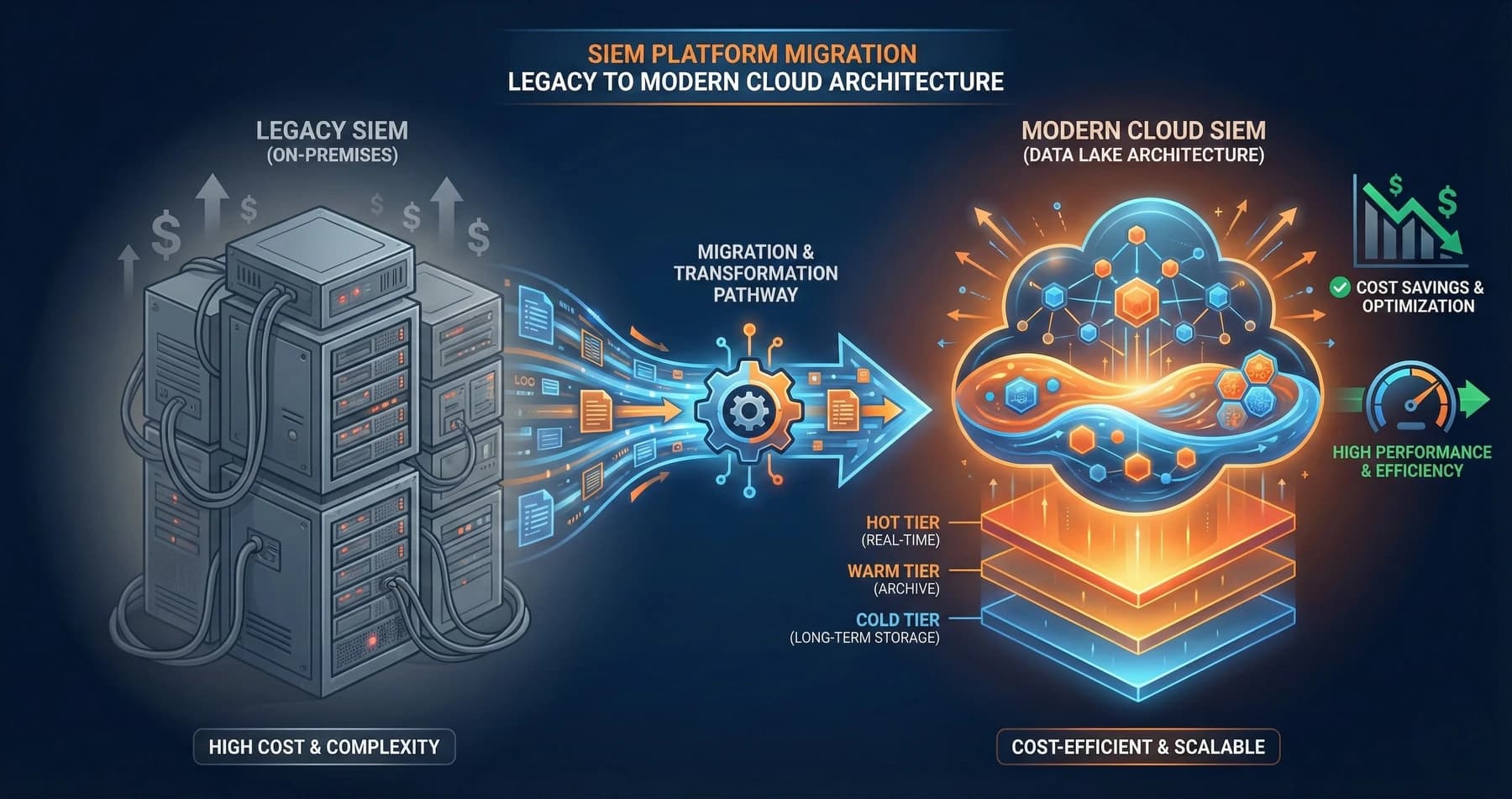
If you're running a traditional SIEM, you're likely facing an uncomfortable reality. Licensing costs increase every year while your data volumes explode. The economics of volume-based SIEM licensing are becoming untenable for many organizations.
The good news is that alternatives exist. Modern security data architectures offer better economics, more flexibility, and often improved capability. The bad news is that migration is complex and risky if not done correctly.
Here's what we've learned from guiding organizations through SIEM transformations.
Signs Your SIEM Is Holding You Back
Migration is disruptive. Don't undertake it unless you have genuine problems to solve:
Cost Problems
- Annual licensing increases exceed budget growth
- You're making data collection decisions based on cost rather than security value
- Ingestion costs force you to drop logs from important sources
- You're retaining data for shorter periods than regulations or investigations require
Capability Problems
- Search performance degrades as data volumes grow
- Detection rules hit performance limits
- Correlation across data sources is limited or slow
- Machine learning and analytics capabilities are inadequate
Operational Problems
- Platform management consumes significant engineering time
- Scaling requires substantial lead time
- Multi-cloud or hybrid environments are difficult to support
- Integration with modern tools is clunky or impossible
Vendor Problems
- Roadmap doesn't align with your security strategy
- Support quality has declined
- Acquisition has created uncertainty
- Community and ecosystem are shrinking
Don't migrate just because a new platform is trendy. Migration carries real risk and cost. Make sure you have concrete problems that the new platform will solve.
Modern Alternatives to Traditional SIEM
The SIEM landscape has fragmented. Understand your options:
Cloud-Native SIEM
Examples: Microsoft Sentinel, Google Chronicle, AWS Security Lake
Characteristics:
- Consumption-based pricing (usually)
- Native cloud integrations
- Managed infrastructure
- Limited customization
Best for: Organizations heavily invested in a single cloud ecosystem who want turnkey security monitoring.
Security Data Lake
Examples: Snowflake with security apps, Databricks security lakehouse, custom solutions on cloud storage
Characteristics:
- Separate storage and compute costs
- Flexible query and analytics
- Bring-your-own detection logic
- Requires more engineering investment
Best for: Organizations with data engineering capability who want maximum flexibility and cost optimization.
Next-Generation SIEM
Examples: Modern SIEM platforms with updated architecture
Characteristics:
- Traditional SIEM model with improved economics
- Often still volume-based but more efficient
- Familiar operational model
- Varied cloud-native support
Best for: Organizations wanting incremental improvement without architectural change.
Hybrid Approaches
Example: Hot/warm/cold tiering across platforms, specialized tools for specific use cases
Characteristics:
- Optimize cost and capability by data type
- Complexity in management and correlation
- Often includes legacy platform in reduced role
Best for: Organizations that can't do a complete migration or have specific capability requirements.
Migration Planning
A successful SIEM migration requires careful planning. We've seen migrations fail when organizations skip these steps.
Phase 1: Assessment (2-4 weeks)
Document current state:
- Complete inventory of data sources and ingestion volumes
- All active detection rules and their logic
- Dashboards and reports in use
- Integrations with other security tools
- Current cost model and pain points
Define requirements:
- Detection capabilities that must be maintained
- Data retention requirements (regulatory and operational)
- Performance requirements for search and correlation
- Integration requirements
- Budget targets
Evaluate options:
- Map requirements to platform capabilities
- Conduct proof-of-concept with top candidates
- Understand true cost model (not just sticker price)
- Assess migration complexity
Phase 2: Design (4-8 weeks)
Architecture decisions:
- Data flow and collection architecture
- Detection rule conversion approach
- Integration architecture with existing tools
- Retention and tiering strategy
Migration approach:
- Parallel operation period (both platforms running)
- Data source migration sequence
- Detection rule migration and validation plan
- Cutover criteria
Resource planning:
- Team skills required (and gaps to address)
- Vendor/contractor involvement
- Timeline with milestones
- Rollback plan
Phase 3: Build (8-16 weeks)
Infrastructure:
- Deploy new platform infrastructure
- Configure data collection
- Establish data pipelines
- Set up access controls
Detection migration:
- Convert priority detection rules
- Validate converted rules against known attacks
- Tune for new platform characteristics
- Document conversion decisions
Integration:
- Connect to SOAR and ticketing systems
- Enable threat intelligence feeds
- Integrate with identity and asset systems
- Establish alerting channels
Phase 4: Parallel Operation (4-8 weeks)
Run both platforms:
- Duplicate data ingestion to both platforms
- Run identical detections on both
- Compare alert quality and timing
- Validate nothing is being missed
Validate thoroughly:
- Test detection rules with simulated attacks
- Verify search performance meets requirements
- Confirm integrations work correctly
- Ensure analysts can operate effectively
Phase 5: Cutover (1-2 weeks)
Execute transition:
- Redirect alerting to new platform
- Disable detections on old platform
- Update runbooks and documentation
- Communicate change to stakeholders
Post-cutover:
- Monitor closely for missed detections
- Rapid response to issues
- Adjust tuning based on production experience
- Maintain old platform access for historical data
Detection Rule Conversion
The hardest part of SIEM migration is often converting detection rules. Approaches vary by complexity:
Simple Conversions
Rules that are straightforward logic (field = value) usually convert easily. Syntax changes, but logic remains identical.
# Old platform
source=firewall action=blocked src_ip IN watchlist

# New platform
SELECT * FROM firewall_logs
WHERE action = 'blocked'
AND src_ip IN (SELECT ip FROM watchlist)
Complex Conversions
Rules involving statistical analysis, time windows, or complex correlation often require redesign for the new platform's capabilities.
Original rule concept: Alert when a user authenticates from more than 3 countries in 24 hours.
The implementation will differ significantly based on platform capabilities for statistical analysis and time-windowed aggregation.
Rules That Don't Convert
Some rules rely on features unique to your current platform. Options:
- Find alternative approaches using new platform capabilities
- Accept capability gap (if risk is low)
- Maintain old platform for specific use cases
- Build custom solution for specific detection
Don't try to convert every rule. Migration is an opportunity to clean up accumulated detection debt. Rules that haven't fired a true positive in years, or generate only false positives, shouldn't be migrated. They should be retired.
Managing Risk During Migration
SIEM migration creates a period of elevated risk. Mitigate through:
Extended Parallel Operation
Don't rush the parallel period. Running both platforms longer costs money but significantly reduces risk. Plan for longer than you think necessary.
Detection Validation
Every converted detection rule should be tested against simulated attacks before relying on it. Atomic Red Team and similar tools are essential.
Phased Data Source Migration
Don't migrate all data sources at once. Start with lower-risk sources, validate, then progress to more critical data.
Clear Rollback Triggers
Define specific conditions that trigger rollback to the old platform. Don't make this a judgment call during a stressful migration.
Stakeholder Communication
Ensure that leadership, auditors, and other stakeholders understand the migration timeline and any temporary capability gaps.
Cost Optimization Strategies
Modern platforms offer cost optimization opportunities that legacy SIEM didn't:
Intelligent Data Tiering
Not all data needs the same access speed:
- Hot tier: Active investigation and real-time detection
- Warm tier: Recent historical data for investigation
- Cold tier: Long-term retention for compliance
Data Transformation
Some data can be aggregated or summarized before storage:
- NetFlow summaries instead of full packet captures
- Failed authentication counts instead of every failed attempt
- Summarized DNS logs instead of every query
Selective Collection
Not every log source provides security value proportional to its volume. Evaluate:
- What detections does this data enable?
- How often is it used in investigations?
- What's the cost per detection/investigation?
Query Optimization
Inefficient queries cost more in consumption-based models:
- Train analysts on efficient query patterns
- Pre-compute common aggregations
- Use scheduled queries instead of ad-hoc for regular reports
ROI Calculation
Build a realistic business case that accounts for:
Cost Factors
- New platform licensing/consumption costs
- Migration project costs (internal + external)
- Parallel operation costs during transition
- Training and skill development
- Integration development
Savings Factors
- Reduced licensing costs (ongoing)
- Reduced infrastructure costs (if moving to SaaS)
- Reduced operational overhead
- Extended retention without cost increase
- Avoided costs of scaling current platform
Risk Factors
- Temporary capability gaps
- Potential for missed detections during migration
- Project delay or failure risk
- Vendor lock-in with new platform
Most migrations we've guided show positive ROI within 18-24 months, with break-even often occurring within the first year after fully deprecating the old platform.
The Bottom Line
SIEM migration is a significant undertaking, but staying on an unsustainable platform isn't a viable long-term strategy. The key is approaching migration methodically:
- Validate that migration solves real problems
- Choose a platform aligned with your capabilities and requirements
- Plan thoroughly before starting
- Invest heavily in detection validation
- Run parallel operation longer than seems necessary
- Optimize costs on the new platform from day one
Done right, SIEM migration can transform your security operations from a cost burden into a strategic capability.
Related Service
Learn more about how we can help with Security Engineering.
Explore Security Engineering Services →