Ransomware remains the most impactful cyber threat facing most organizations. Despite increased attention, improved defenses, and occasional law enforcement successes, ransomware attacks continue. The economics still favor attackers.
Here's what the current ransomware landscape looks like and what organizations should focus on for defense.
2025-2026 Ransomware Evolution
The ransomware ecosystem has matured and professionalized:
Double and Triple Extortion
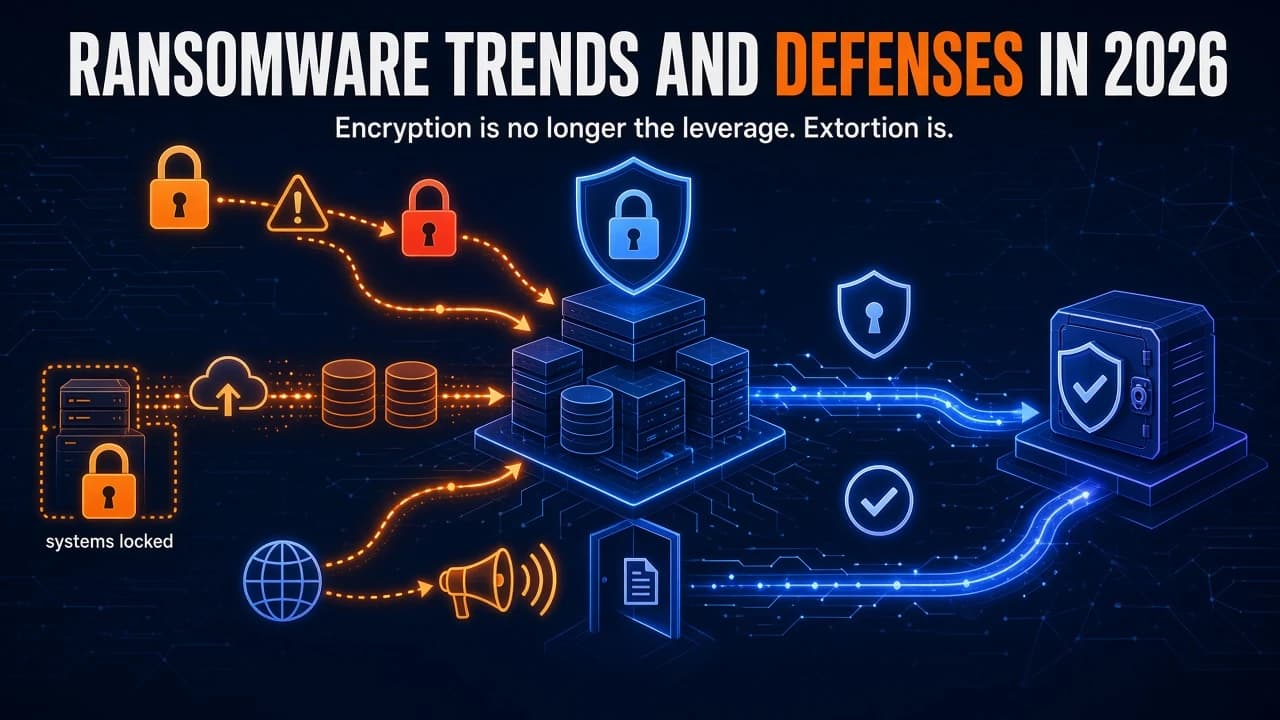
Encryption alone is no longer the primary leverage. Modern ransomware operations typically:
- Exfiltrate data before encryption - Creates leverage even if backups work
- Threaten public release - Reputational and regulatory implications
- Contact customers, partners, or regulators - Third-party pressure tactics
Some groups have added DDoS attacks as a third extortion vector, disrupting operations during negotiations.
Ransomware-as-a-Service (RaaS) Dominance
The RaaS model has become the dominant operating structure:
- Core developers build and maintain ransomware platforms
- Affiliates conduct attacks using the platform
- Revenue sharing (typically 70-80% to affiliates)
- Support infrastructure including negotiation services
This model enables specialization. Affiliates focus on initial access and deployment while developers focus on evasion and functionality.
Initial Access Brokers
Attackers increasingly purchase initial access rather than gaining it themselves:
- Compromised VPN credentials
- Stolen session tokens
- Web shell access
- Existing malware infections
The time from initial compromise to ransomware deployment has shortened significantly as attackers buy their way past perimeter defenses.
Targeting Shifts
We've observed shifts in targeting:
Healthcare remains heavily targeted due to sensitivity of operations and data.
Manufacturing faces increased targeting for operational disruption leverage.
Education continues as a frequent target due to often limited security resources.
Professional services (law firms, accountants) targeted for client data.
Critical infrastructure sees continued attention, though with varying attacker caution due to law enforcement response.
The median time from initial access to ransomware deployment has dropped to under 24 hours in many cases. Organizations that relied on "time to detect and respond" now have very little window. Prevention and rapid detection are critical.
Notable Attack Patterns
Several attack patterns have proven particularly effective:
Exploitation of Edge Devices
VPN appliances, firewalls, and other edge devices remain primary entry points:
- Rapid exploitation of published vulnerabilities
- Targeting of unpatched devices
- Use of zero-day or recently published exploits
Defensive implication: Edge device patching must be treated with the same urgency as critical server patching.
Identity-Based Attacks
Credential theft and abuse enables attackers to move laterally without deploying malware:
- Phishing for credentials
- Purchase of stolen credentials
- Exploitation of SSO and identity providers
- Abuse of legitimate remote access tools
Defensive implication: Identity protection (MFA, PAM, unusual access detection) is as important as traditional malware defense.
Living Off the Land
Attackers increasingly use legitimate tools already present in environments:
- PowerShell for execution
- WMI for lateral movement
- RDP for access
- Administrative tools for reconnaissance
Defensive implication: Behavioral detection matters more than signature-based detection.
Supply Chain Compromise
Software supply chain attacks enable mass compromise:
- Compromised software updates
- Malicious packages in repositories
- Third-party access abuse
Defensive implication: Vendor security assessment and supply chain monitoring are essential.
Defensive Controls That Matter
Not all security investments are equal against ransomware. Focus on controls with demonstrated effectiveness:
Identity Security
The majority of ransomware attacks involve credential compromise at some stage:
Critical controls:
- Multi-factor authentication everywhere possible
- Privileged access management for administrative accounts
- Detection of unusual authentication patterns
- Rapid response to compromised credentials
Endpoint Protection
Modern EDR capabilities are essential:
Critical controls:
- EDR with behavioral detection (not just signatures)
- Controlled folder access / ransomware protection features
- Local administrator password management
- Application control for critical systems
Network Segmentation
Limit lateral movement opportunities:
Critical controls:
- Microsegmentation of critical assets
- Restricted administrative access between segments
- Monitored and limited internet access for servers
- No direct RDP exposure to internet
Vulnerability Management
Edge devices and internet-facing systems are primary entry points:
Critical controls:
- Rapid patching of edge devices (VPN, firewall, email gateways)
- Vulnerability scanning with aggressive SLAs
- Internet exposure monitoring
Detection and Response
When prevention fails, detection speed matters:
Critical controls:
- 24x7 monitoring capability
- Detection for common ransomware precursors
- Tested incident response procedures
- Isolation capability (network and endpoint)
Backup and Recovery Strategy
Backups are the last line of defense. They must be designed to survive ransomware attacks:
Immutable Backups
Backups that cannot be modified or deleted even with administrative credentials:
- Write-once storage
- Air-gapped backup copies
- Cloud backups with deletion protection
Backup Testing
Untested backups are assumptions, not capabilities:
- Regular restore testing (at least quarterly)
- Full system recovery exercises
- Documentation of recovery procedures
- Validation of recovery time objectives
Backup Segmentation
Backup infrastructure should be isolated from production:
- Separate credentials for backup systems
- Network segmentation of backup infrastructure
- Monitoring for backup deletion or modification
Recovery Planning
Ransomware recovery is not just "restore from backup":
- Prioritized recovery order for systems
- Clean recovery environment procedures
- Validation process before reconnection
- Communication plan during extended outage
Organizations with tested, immutable backups and practiced recovery procedures routinely decline ransom demands. Those with untested backups or backups accessible to attackers often have no choice but to negotiate.
Incident Response for Ransomware
When ransomware hits, the first 24 hours are critical:
Immediate Actions (First Hour)
- Contain the spread - Isolate affected systems and segments
- Preserve evidence - Don't immediately wipe systems
- Assess scope - Determine how many systems are affected
- Activate response team - Internal team, external support, legal
Investigation (Hours 1-24)
- Identify initial access - How did attackers get in?
- Map lateral movement - What systems were accessed?
- Determine data exposure - What data may have been exfiltrated?
- Assess backup integrity - Are backups available and clean?
Decision Points
To pay or not to pay?
This decision should involve:
- Assessment of backup viability
- Analysis of attacker reliability (do they actually provide decryptors?)
- Legal considerations (sanctions compliance)
- Regulatory implications
- Business impact of extended outage
There's no universal right answer, but paying should be a last resort after other options are exhausted.
Recovery
- Clean environment preparation - Don't restore into a compromised environment
- Prioritized system recovery - Business-critical systems first
- Validation before reconnection - Ensure systems are clean
- Enhanced monitoring - Watch for persistent access
Building Organizational Resilience
Beyond technical controls, organizational factors determine ransomware resilience:
Security Culture
- Regular security awareness focused on current threats
- Clear reporting channels for suspicious activity
- No blame culture for reporting potential incidents
- Executive support for security initiatives
Tested Response Capability
- Annual tabletop exercises with realistic scenarios
- Technical drills for containment and recovery
- Communication exercises with stakeholders
- Relationship building with law enforcement and incident response firms before needed
Cyber Insurance
Insurance can help with recovery costs but:
- Coverage terms are increasingly restrictive
- Requirements often mandate specific controls
- Claims require documentation of security posture
- Insurance is not a substitute for security controls
Business Continuity
- Understand critical business processes and their system dependencies
- Plan for extended outages (not just hours, but days or weeks)
- Manual procedures for essential operations
- Communication plans for customers and partners
What's Next
Ransomware will continue evolving. Anticipated trends:
- Increased targeting of cloud environments as more assets move to cloud
- AI-enhanced attacks improving social engineering and evasion
- Faster deployment reducing detection window further
- More aggressive extortion tactics beyond encryption
- Targeting of backup infrastructure directly
The Bottom Line
Ransomware defense requires:
- Strong identity security - MFA, PAM, unusual access detection
- Modern endpoint protection - EDR with behavioral detection
- Network segmentation - Limit lateral movement
- Rapid vulnerability management - Especially for edge devices
- Resilient backups - Immutable, tested, isolated
- Practiced response - Know what to do before it happens
No organization is immune. The goal is resilience: the ability to prevent most attacks, detect what gets through quickly, and recover when prevention and detection fail.
Related Service
Learn more about how we can help with Security Operations.
Explore Security Operations Services →