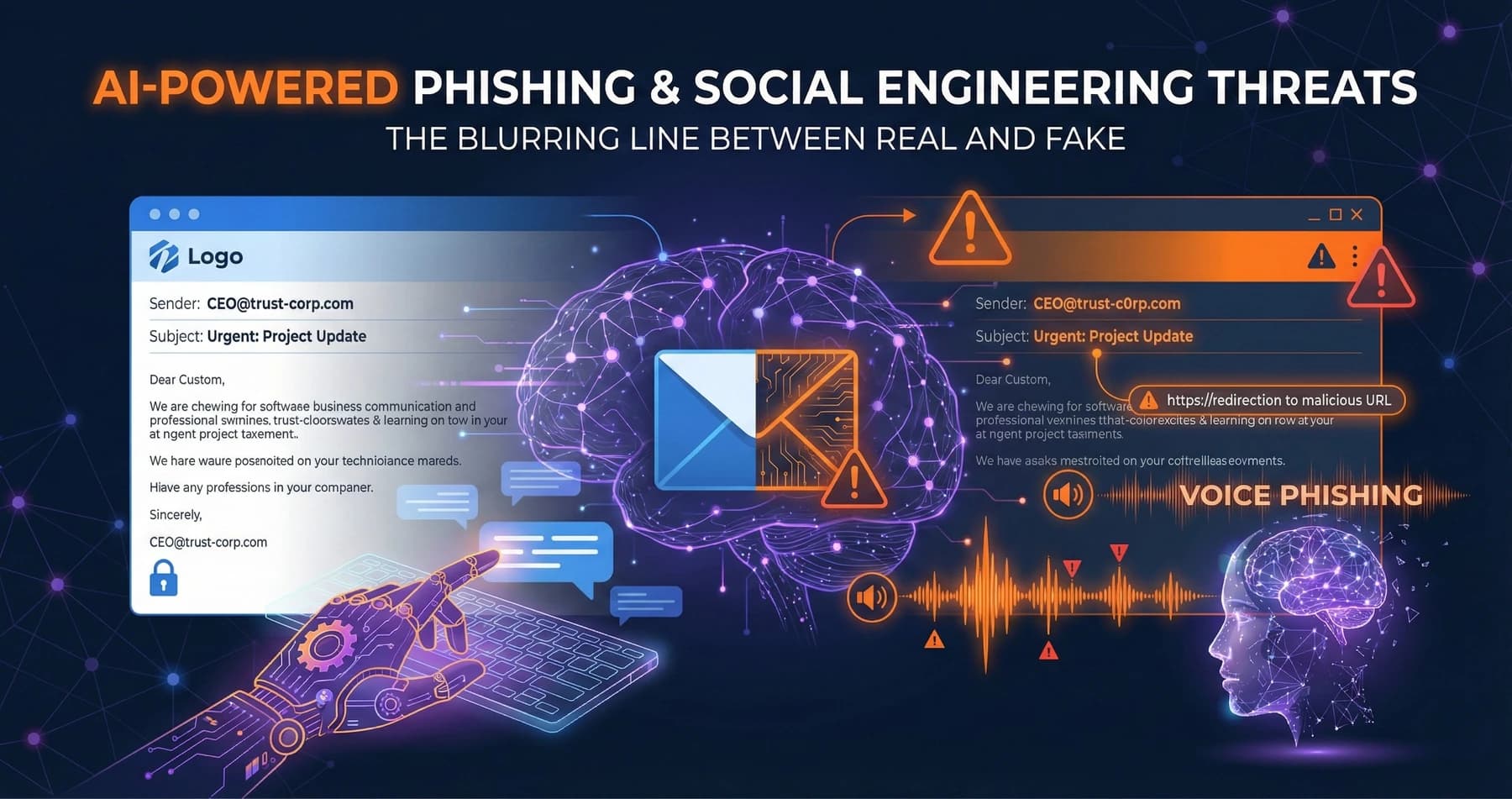
Remember when you could spot phishing emails by their broken English and Nigerian prince narratives? Those days are over.
Large language models have given attackers the ability to craft perfectly written, contextually appropriate messages at scale. Deepfake technology allows them to clone voices and even faces. The result is a new generation of social engineering attacks that your traditional defenses weren't designed to stop.
The Evolution of Phishing
To understand where we are, it helps to understand how we got here.
Generation 1: Spray and Pray (1990s-2010s)
The early days of phishing were characterized by mass-distributed, poorly crafted messages. The "Dear Valued Customer" emails with obvious grammatical errors and generic threats. These attacks succeeded through volume: send enough emails and some small percentage would click.
Defenses that worked: Basic email filtering, user awareness of obvious red flags.
Generation 2: Targeted Attacks (2010s)
Spear phishing and business email compromise (BEC) emerged as attackers realized that targeted, well-researched messages were far more effective than mass campaigns. Attackers invested time researching their targets using LinkedIn, company websites, and social media.
Defenses that worked: Training users to verify unusual requests, email authentication (DMARC/DKIM/SPF), executive impersonation detection.
Generation 3: AI-Augmented Attacks (2024-Present)
We're now seeing attacks that combine the personalization of targeted attacks with the scale of mass campaigns. LLMs enable attackers to generate thousands of unique, contextually appropriate messages. Deepfakes enable voice and video impersonation. The economics of sophisticated attacks have fundamentally changed.
Defenses that work: That's what this article is about.
How Attackers Are Using AI
The threat landscape has shifted in several concrete ways:
Perfect Grammar at Scale
Previously, creating a convincing phishing email required either native language skills or significant time investment. Now, an attacker can describe the scenario they want to create, and an LLM will generate a professionally written message in any language.
Real-world example: We've observed campaigns where every recipient received a unique message referencing their actual job title, company, and recent news about their organization. Each message was grammatically perfect and stylistically consistent with legitimate business communication.
Voice Cloning for Vishing
Voice phishing (vishing) attacks have been supercharged by AI voice cloning. With as little as 30 seconds of audio (easily obtained from YouTube interviews, earnings calls, or social media) attackers can generate convincing voice impersonations.
In one incident we investigated, attackers cloned a CFO's voice from a publicly available conference presentation. They called the accounting department requesting an "urgent wire transfer" for a confidential acquisition. The voice was convincing enough that the employee processed a $2.3 million transfer before verification procedures caught the fraud.
Video Deepfakes for Executive Impersonation
While still less common than voice attacks, video deepfakes are becoming increasingly accessible. We've seen attempts to use deepfaked video calls to authorize transactions and validate identity.
Automated Reconnaissance
AI tools can rapidly process public information about targets (LinkedIn profiles, company news, social media posts) to generate highly personalized pretexts. What once required hours of manual research can now be automated.
Why Traditional Defenses Are Failing
The defenses we've relied on for years were designed for earlier generations of attacks. They're increasingly ineffective against AI-augmented threats.
Email Security Limitations
Traditional email security looks for:
- Known malicious domains and IP addresses
- Suspicious attachments and links
- Common phishing phrases and patterns
- Technical indicators of spoofing
AI-generated phishing bypasses most of these controls because:
- Attackers use fresh infrastructure with no reputation
- Messages may contain no links or attachments initially (pure social engineering)
- Each message is unique, avoiding pattern-based detection
- Authentication can be legitimate if using compromised accounts
User Training Gaps
We've trained users to look for:
- Poor grammar and spelling
- Urgency and threats
- Requests for sensitive information
- Suspicious sender addresses
These indicators are no longer reliable:
- AI-generated content has perfect grammar
- Sophisticated attacks use appropriate urgency that mirrors legitimate business
- Initial contact may not request anything sensitive
- Attackers increasingly use compromised legitimate accounts or carefully spoofed domains
Defenses That Actually Work
Stopping AI-powered social engineering requires a layered approach that doesn't rely solely on users spotting "obvious" attacks.
1. Verification Procedures for High-Risk Requests
The most effective defense against sophisticated impersonation is out-of-band verification. This means:
For financial transactions:
- Verify any payment changes or unusual requests through a known phone number (not one provided in the email)
- Require verbal confirmation for transactions above defined thresholds
- Implement callback procedures using previously established contact information
For credential and access requests:
- Verify requests for password resets or MFA changes through alternative channels
- Use ticket systems that require authenticated submissions
- Establish code words for verifying identity in sensitive situations
The key principle: if a request could cause significant harm if fraudulent, verify it through a channel the attacker doesn't control. An email requesting a wire transfer should be verified by phone to a known number, not by replying to the email.
2. Modern Email Security
While not sufficient alone, email security should be updated to address AI-generated threats:
Behavioral analysis:
- Detect anomalies in communication patterns (new contacts requesting sensitive actions)
- Identify unusual writing styles from known senders (potential account compromise)
- Flag communications that deviate from established workflows
Advanced impersonation detection:
- Look-alike domain detection beyond simple homograph attacks
- Display name spoofing detection with user notification
- Analysis of reply-to manipulation and routing anomalies
AI-based detection:
- Some newer tools use AI to identify AI-generated content
- Detection of synthetic media in attachments
- Analysis of message timing and sending patterns
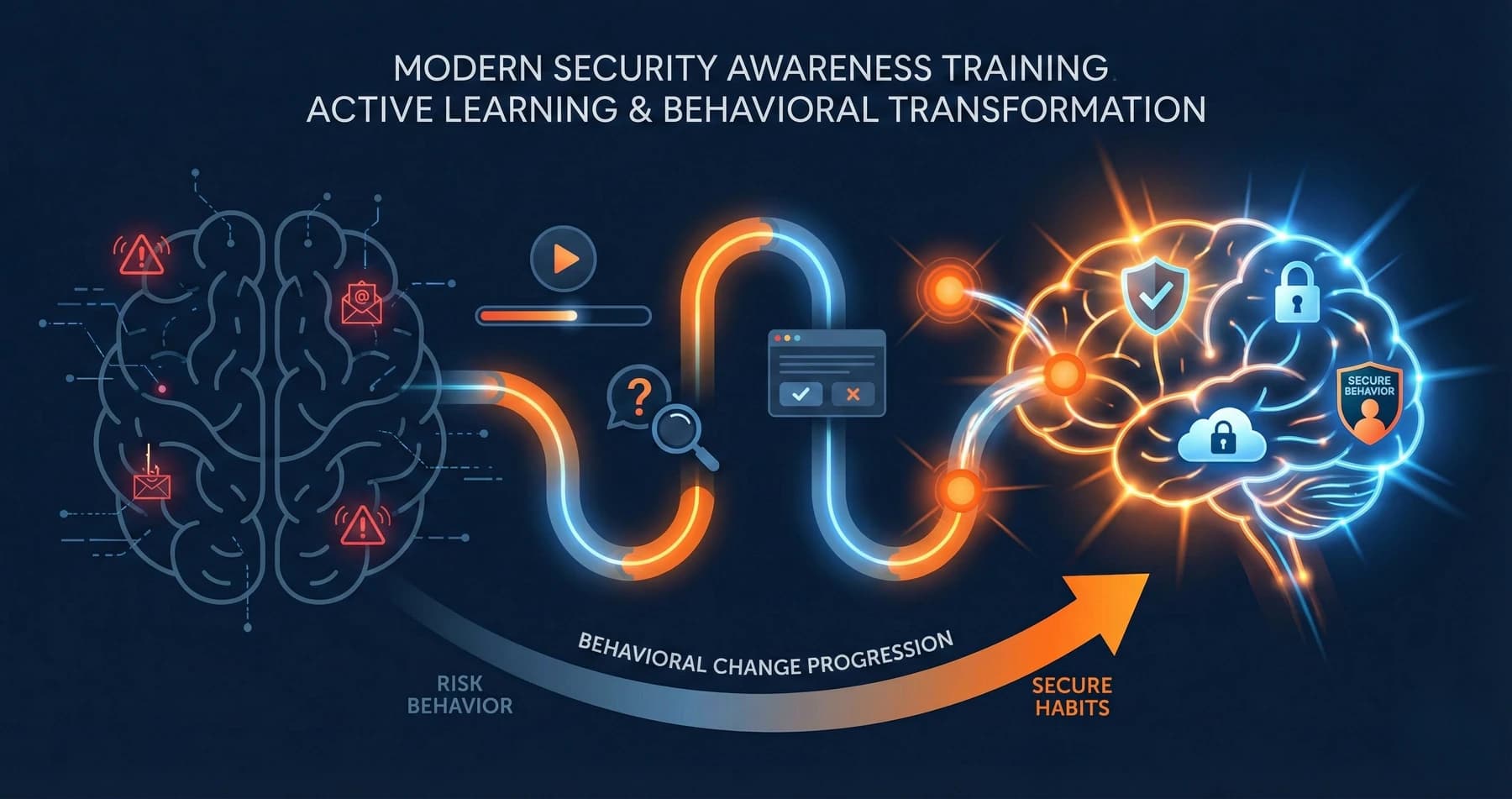
3. Behavior-Based Security Awareness
Training must evolve beyond "spot the red flags" to focus on secure behaviors regardless of how convincing an attack appears:
Process-based training:
- Focus on following verification procedures, not spotting attacks
- Practice scenarios where the "attack" is indistinguishable from legitimate requests
- Measure behavior (following procedure) not just awareness (answering quiz questions)
Just-in-time guidance:
- Provide warnings at the moment of risky actions
- Integrate security prompts into financial systems and sensitive workflows
- Use positive reinforcement when users follow secure procedures
Realistic simulations:
- Move beyond obvious phishing tests to sophisticated, AI-assisted simulations
- Include vishing and other multi-channel attacks
- Focus on testing process adherence, not just click rates
4. Technical Controls for Voice and Video
As deepfakes become more common, technical verification becomes essential:
Voice verification:
- Implement code words or phrases that must be used for high-risk authorizations
- Consider voice authentication technology (while imperfect, it adds friction for attackers)
- Require video confirmation for the highest-risk transactions
Video call security:
- Train users on the current limitations and artifacts of deepfake video
- For highly sensitive meetings, verify attendees through separate channels
- Consider recording high-risk calls for later review
5. Reducing the Attack Surface
Limit what attackers can learn and use against you:
Executive exposure management:
- Audit publicly available audio and video of executives
- Consider limiting availability of recorded earnings calls and presentations
- Implement executive protection services for high-risk individuals
Information security:
- Review what organizational information is publicly available
- Limit detailed organizational charts and reporting structures
- Train employees on what information shouldn't be shared publicly
Building Resilience
The goal isn't to prevent every attack. That's impossible. The goal is to build organizational resilience that limits damage when attacks succeed.
Assume Compromise
Design processes assuming that some social engineering will succeed:
- Separation of duties for high-risk actions
- Mandatory verification steps that don't rely on a single person
- Limits on what any single compromised account can accomplish
Detection and Response
Ensure you can detect and respond when attacks succeed:
- Monitor for anomalous financial transactions
- Alert on unusual access patterns
- Have incident response procedures for suspected social engineering
Regular Testing
Continuously test your defenses:
- Conduct sophisticated, realistic phishing simulations
- Include vishing and multi-channel attacks
- Test verification procedure compliance
- Evaluate response when simulated attacks "succeed"
The Uncomfortable Truth
AI has shifted the advantage to attackers in social engineering. A well-resourced attacker can now create attacks that are nearly indistinguishable from legitimate communications.
The answer isn't better training to spot attacks. The attacks will be too good. The answer is robust processes that verify high-risk requests regardless of how convincing they appear.
Organizations that rely solely on users to identify sophisticated attacks will have incidents. Organizations that implement verification procedures and assume some attacks will be convincing have a fighting chance.
Related Service
Learn more about how we can help with Security Awareness & Training.
Explore Security Awareness & Training Services →