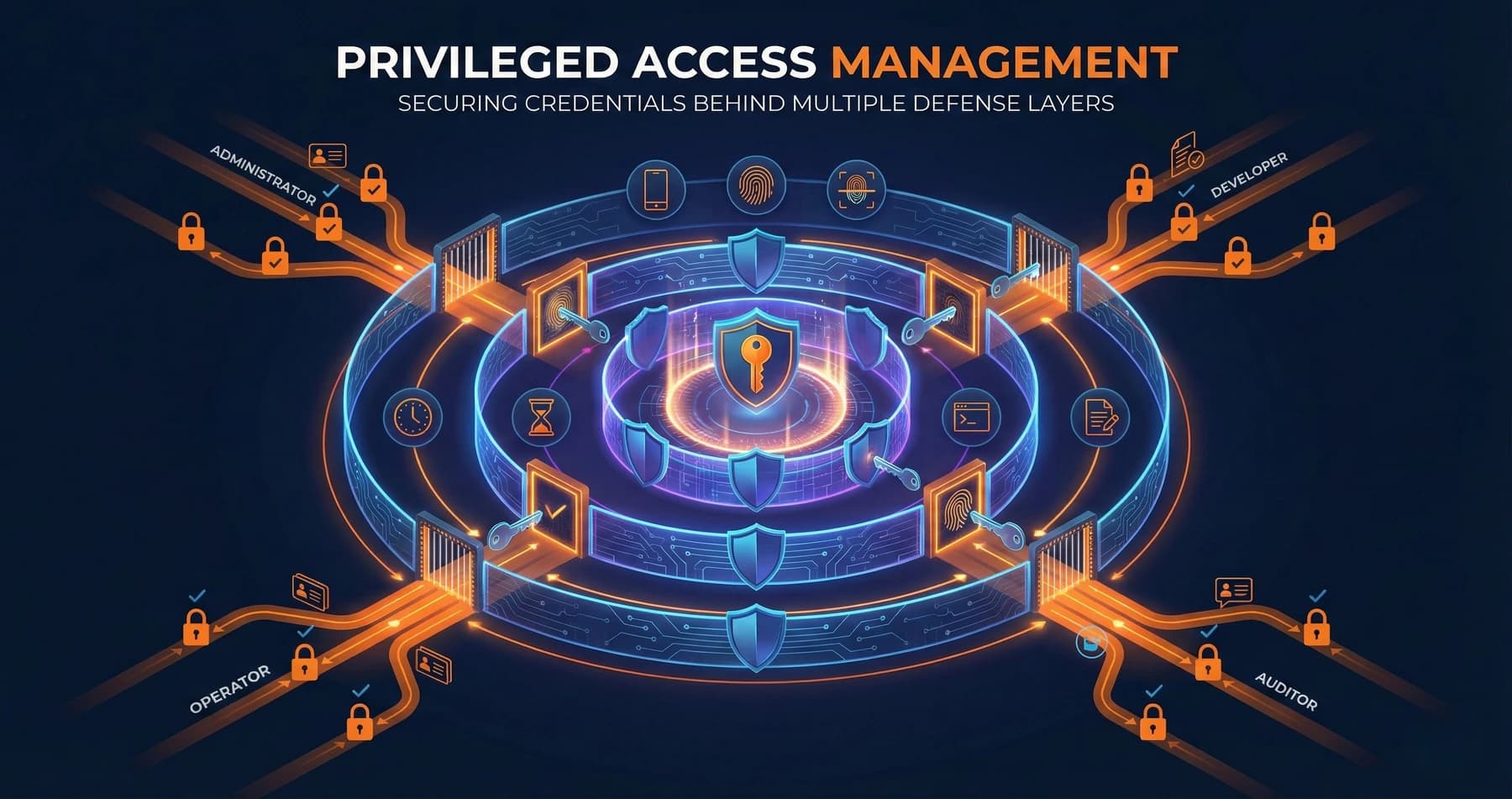
Privileged Access Management (PAM) solutions promise to solve one of security's oldest problems: too many people with too much access to too many systems.
The reality is messier. PAM implementations frequently stall, get scoped down to insignificance, or become shelfware that technically exists but doesn't actually reduce risk. After leading PAM deployments at organizations ranging from mid-market to Fortune 50, we've identified the patterns that separate success from failure.
The PAM Implementation Maturity Curve
Most organizations progress through predictable stages:
Stage 1: Vault the Crown Jewels
Focus: Get the most critical credentials into the vault.
Characteristics:
- Vault domain admin accounts and root credentials
- Basic checkout/checkin workflow
- Manual password rotation
- Limited session recording
Risk reduction: Meaningful but narrow. Protects against simple credential theft but leaves most access uncontrolled.
Stage 2: Expand Coverage
Focus: Bring more credential types under management.
Characteristics:
- Application and service accounts
- Database administrator credentials
- Network device access
- Cloud platform privileged access
Risk reduction: Significant expansion of protection but still relies on users following the process.
Stage 3: Enforce Usage
Focus: Make the PAM solution the only way to access privileged systems.
Characteristics:
- Eliminate direct login with privileged credentials
- Just-in-time access provisioning
- Automated discovery of unmanaged accounts
- Integration with identity governance
Risk reduction: Major improvement. Privileged access without PAM becomes impossible, not just discouraged.
Stage 4: Zero Standing Privileges
Focus: No persistent privileged access exists.
Characteristics:
- All privileged access is just-in-time
- Automated provisioning and deprovisioning
- Full session recording and monitoring
- Behavioral analytics for anomaly detection
Risk reduction: Optimal. Even if credentials are compromised, no standing access exists to exploit.
Most organizations we encounter are stuck between Stage 1 and Stage 2. Getting to Stage 3 and beyond requires addressing the common failure modes.
Common Failure Modes (And How to Avoid Them)
Failure: Underestimating Change Management
PAM changes how people work. Administrators who previously had credentials memorized now must go through a checkout process. Automated processes that used embedded credentials must be re-architected.
Resistance is predictable: "This slows us down." "What if PAM is unavailable?" "I need direct access for emergencies."
The fix: Invest in change management equal to the technology investment.
- Communicate the why before the what
- Involve affected teams in workflow design
- Create clear break-glass procedures for emergencies
- Demonstrate executive commitment
- Celebrate early adopters
Technical deployments that fail rarely fail for technical reasons. They fail because people find ways to work around controls they don't understand or believe in. Budget at least 30% of your PAM program resources for change management.
Failure: Boiling the Ocean
Attempts to vault everything at once typically achieve nothing. The project becomes so large that it never completes, or the scope is quietly reduced until the implementation covers only a handful of accounts.
The fix: Phased onboarding with clear priorities.
Phase 1 (Months 1-3): Tier 0 assets only
- Domain controllers
- PKI infrastructure
- Hypervisor management
- PAM infrastructure itself
Phase 2 (Months 4-6): Expand to Tier 1
- Key servers and databases
- Security infrastructure
- Backup systems
Phase 3 (Months 7-12): Service accounts and applications
- Database service accounts
- Application service accounts
- API credentials
Phase 4 (Year 2): Broad coverage
- Workstation local admin
- Cloud IAM privileged roles
- Third-party vendor access
Failure: Ignoring Service Accounts
Human privileged accounts get all the attention, but service accounts often represent greater risk. They're typically:
- More numerous than human accounts
- Shared across multiple systems
- Never rotated
- Not monitored
- Connected to critical processes
The fix: Include service accounts from the beginning.
- Discovery first: You can't protect what you don't know exists
- Application owner engagement: Identify who's responsible for each service account
- Rotation planning: Some accounts can rotate automatically; others need application changes
- Dependency mapping: Understand what breaks if a credential changes
Failure: Poor Integration
A PAM solution that exists as an island doesn't deliver its potential value. Critical integrations include:
Identity Governance (IGA):
- Access requests should flow through governance workflows
- Certification campaigns should include privileged access
- Joiner/mover/leaver processes should update PAM entitlements
SIEM and Security Operations:
- PAM events should flow to your SIEM
- Anomalous privileged access should trigger alerts
- Session recordings should be searchable during investigations
ITSM:
- Access requests should create tickets
- Emergency access should generate incidents
- Audit evidence should be accessible
The fix: Plan integrations as part of the core implementation, not as phase 2.
Failure: Insufficient Emergency Access Procedures
"What if PAM is down?" is the question that derails many implementations. Without a clear answer, users maintain backdoor access "just in case," undermining the entire program.
The fix: Design robust break-glass procedures.
- Secure offline credential storage (physical safe with combination known to limited personnel)
- Clear escalation path for who can authorize break-glass
- Automated monitoring that alerts on break-glass usage
- Mandatory incident creation for any break-glass access
- Regular testing of break-glass procedures
Measuring PAM Program Success
Track metrics that indicate actual risk reduction, not just deployment progress:
Coverage Metrics
| Metric | Target | Calculation |
|---|---|---|
| Tier 0 account coverage | 100% | Accounts in PAM / Total Tier 0 accounts |
| Service account coverage | >80% | Managed service accounts / Total discovered |
| Session recording coverage | >90% | Recorded sessions / Total privileged sessions |
Usage Metrics
| Metric | Target | Significance |
|---|---|---|
| Direct login attempts | 0 | Any direct logins indicate gaps |
| Average checkout duration | Under 8 hours | Long checkouts suggest standing access |
| Check-ins without activity | Under 5% | May indicate credential sharing |
Security Metrics
| Metric | Target | Significance |
|---|---|---|
| Password age (unmanaged accounts) | None should exist | Discovery effectiveness |
| Time to revoke terminated user access | Under 1 hour | Joiner/mover/leaver integration |
| Anomalous access alerts | Reviewed 100% | Monitoring effectiveness |
When to Upgrade or Migrate
PAM platforms aren't forever. Consider migration when:
Technical limitations:
- Current platform doesn't support cloud workloads adequately
- No path to zero standing privileges
- Session recording quality is insufficient
- Performance doesn't scale with your environment
Vendor concerns:
- Significant price increases
- Declining product investment
- Support quality issues
- Acquisition that creates uncertainty
Architectural changes:
- Major cloud migration makes cloud-native PAM attractive
- Zero trust initiative requires different capabilities
- Consolidation opportunity with broader identity platform
Migration is expensive and risky. Don't undertake it lightly, but don't stay on a platform that can't meet your security requirements either.
Cloud PAM Considerations
Cloud environments present unique PAM challenges:
IAM Role Management
Cloud IAM roles are privileged access, even if they don't involve traditional passwords. Your PAM strategy should address:
- How are powerful IAM roles granted?
- Is access just-in-time or standing?
- Are role assumptions logged and monitored?
- How is access certified and reviewed?
Multi-Cloud Complexity
Organizations with AWS, Azure, and GCP face fragmented privileged access. Options include:
- Cloud-native PAM for each platform (complexity, but best native integration)
- Unified PAM platform with cloud connectors (simpler management, potential capability gaps)
- Cloud PAM specialist solution (deep cloud capability, may not address on-prem)
Ephemeral Infrastructure
Containers and serverless functions change the privileged access model. Consider:
- Secrets management for application credentials
- Service mesh integration for service-to-service authentication
- Dynamic secrets that are created and destroyed automatically
Building the Business Case
PAM investments require executive support. Frame the business case around:
Risk reduction:
- Percentage of breaches involving compromised credentials (>80%)
- Average cost of privileged access-related breaches
- Specific risks in your environment
Compliance:
- Regulatory requirements for privileged access control
- Audit findings related to credential management
- Industry standards (PCI-DSS, SOC 2, HIPAA)
Operational efficiency:
- Reduced password reset burden
- Automated provisioning/deprovisioning
- Simplified audit evidence collection
Insurance implications:
- Cyber insurance questionnaires increasingly ask about PAM
- Premium implications of strong vs. weak controls
The Path Forward
If you're early in your PAM journey:
-
Discovery first: You can't protect what you don't know exists. Inventory all privileged accounts, including service accounts.
-
Start with Tier 0: Protect domain controllers and other critical infrastructure first.
-
Plan for service accounts: Don't leave them for "later." They're often more dangerous than human accounts.
-
Invest in change management: Technical deployment is the easy part.
-
Integrate from the start: PAM that's an island delivers limited value.
-
Measure meaningful metrics: Track risk reduction, not just deployment checkboxes.
PAM done right transforms your security posture. PAM done poorly is expensive software that sits unused while credentials remain the top attack vector.
Related Service
Learn more about how we can help with Identity & Access Management.
Explore Identity & Access Management Services →