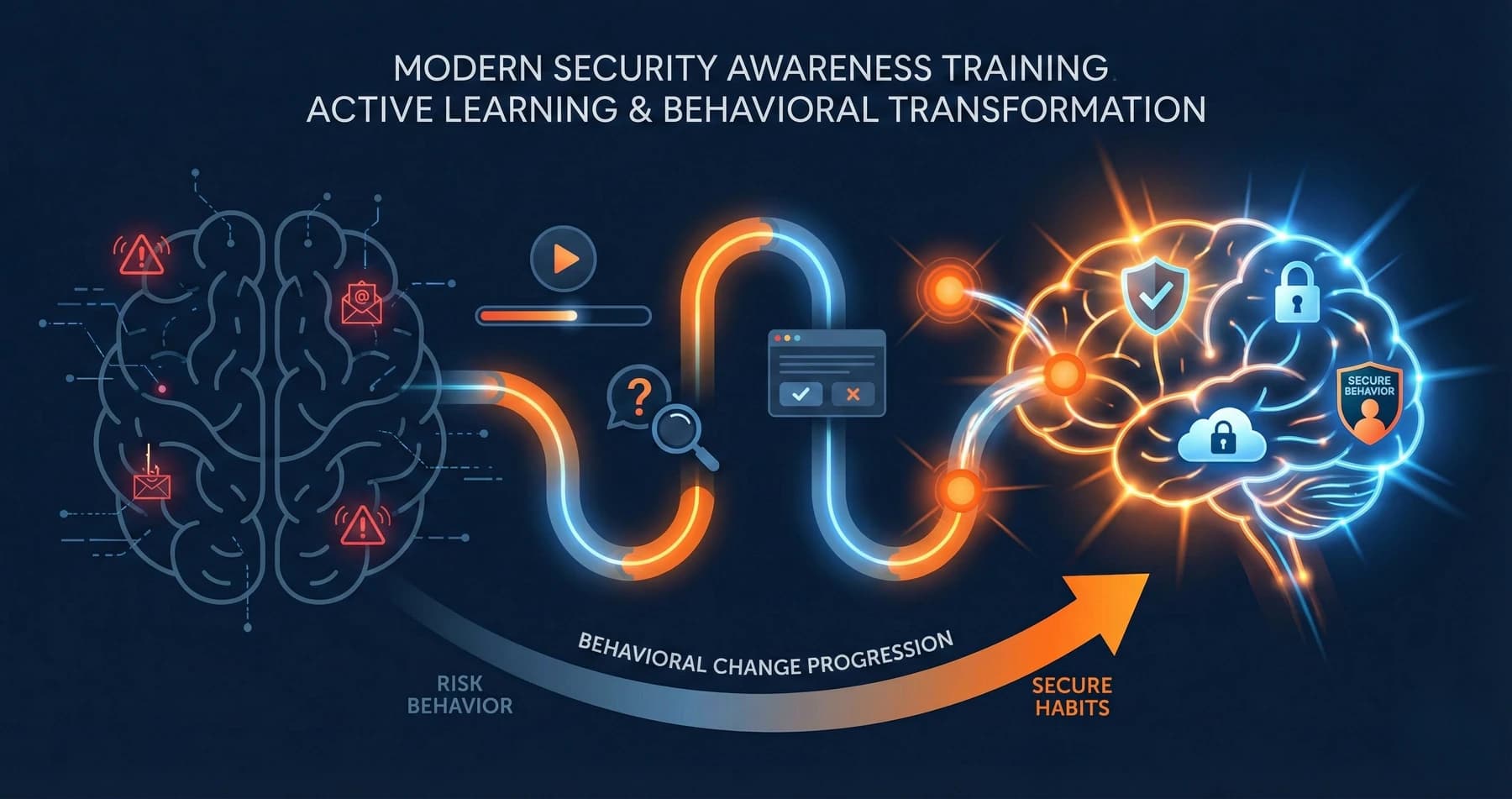
Every organization has a security awareness program. Annual training. Posters in break rooms. Maybe a monthly newsletter. And despite all this, employees still click phishing links, use weak passwords, and fall for social engineering.
The problem isn't that employees don't know security matters. It's that traditional awareness programs don't change behavior. And behavior is what actually matters.
Why Traditional Training Fails
Understanding why current approaches don't work is the first step to building programs that do.
The Compliance Trap
Most awareness programs exist to satisfy compliance requirements:
- Annual training: Check.
- Quiz completion documented: Check.
- Training records for auditors: Check.
The goal becomes training completion, not behavior change. And organizations get exactly what they measure -completed training modules, not secure behaviors.
Irrelevant Content
Generic training covering topics that don't apply to specific roles creates disengagement:
- The finance team doesn't need deep training on physical security
- Developers need different content than administrative assistants
- Executives face different threats than individual contributors
One-size-fits-all content means nobody gets relevant training.
Passive Consumption
Watching videos and clicking through slides doesn't create lasting behavior change:
- Attention wanders during passive content
- Information is forgotten within days
- No connection to actual work situations
- No opportunity to practice skills
Negative Framing
Fear-based training ("You'll get fired if you cause a breach!") creates:
- Anxiety rather than competence
- Avoidance of security rather than engagement
- Reluctance to report mistakes
- Security seen as punishment rather than enablement
One-Time Events
Annual training treats security as a one-time event rather than ongoing:
- Skills decay over time
- Threat landscape changes throughout the year
- No reinforcement of learning
- No adaptation based on individual performance
Research consistently shows that people forget 70% of training content within 24 hours and 90% within a week -unless there's reinforcement. Annual training is nearly worthless for long-term behavior change.
The Psychology of Security Behavior
Building effective awareness programs requires understanding how humans actually change behavior.
Motivation
People change behavior when they:
See personal relevance "This could happen to me" is more powerful than "This happens to organizations."
Understand the why Explaining the reason behind security requirements increases compliance.
Feel capable People who believe they can do something are more likely to try.
Ability
Even motivated people won't change behavior if it's too difficult:
Friction matters Every additional step reduces compliance. Security must be as easy as possible.
Skills require practice People need opportunities to practice new behaviors in low-stakes environments.
Feedback accelerates learning Immediate feedback on actions helps people learn faster.
Triggers
Even motivated, capable people need prompts to act:
Timely cues Reminders at the moment of decision are more effective than training weeks earlier.
Environmental design Design environments to make secure behavior the easy default.
Social proof People follow what they see others doing.
Building Programs That Work
Effective security awareness programs incorporate these psychological principles:
Role-Based Content
Different roles face different threats:
Executives
- Business email compromise
- Social engineering using public information
- Physical security during travel
- Personal device security
Finance
- Wire fraud and payment diversion
- Invoice manipulation
- Vendor impersonation
- Unauthorized access to financial systems
Developers
- Secure coding practices
- Secrets management
- Supply chain security
- Social engineering targeting code repositories
All Employees
- Phishing recognition and reporting
- Password and authentication security
- Physical security basics
- Incident reporting
Just-in-Time Training
Deliver training at the moment it's relevant:
After risky actions When someone clicks a simulated phishing link, immediate training is far more effective than waiting until the next annual session.
During workflow Prompts when accessing sensitive systems or performing high-risk actions.
Based on current threats Brief alerts when relevant threats are active (e.g., current phishing campaign targeting your industry).
Active Learning
Move beyond passive video consumption:
Simulations Realistic phishing simulations, social engineering calls, and other hands-on exercises.
Scenario-based training Present situations and ask employees to make decisions, then show consequences.
Games and competitions Gamification increases engagement when designed well.
Practice opportunities Let employees practice recognizing threats in low-stakes environments.
Continuous Reinforcement
Security awareness must be ongoing:
Regular touchpoints Monthly micro-training (5-10 minutes) maintains awareness better than annual marathons.
Varied formats Mix videos, interactive modules, newsletters, posters, and discussions.
Spaced repetition Revisit key concepts at increasing intervals to cement long-term memory.
Positive Culture
Frame security as enablement, not punishment:
Celebrate reporting Reward employees who report suspicious activity, even false positives.
No blame for mistakes Create psychological safety to report issues without fear.
Security as protection Frame security as protecting employees' work and customers, not just compliance.
Measuring Behavior, Not Completion
Traditional metrics focus on training completion. Effective programs measure behavior change:
Behavioral Metrics
| Metric | What It Measures | Target |
|---|---|---|
| Phishing click rate | Susceptibility to phishing | Declining trend |
| Phishing report rate | Active threat identification | Over 50% of simulations reported |
| Time to report | Speed of threat identification | Under 5 minutes average |
| Secure behavior observations | Real-world behavior | Improving scores |
| Repeat offender rate | Individual improvement | Under 10% multiple failures |
Leading Indicators
| Metric | What It Indicates |
|---|---|
| Training engagement scores | Content relevance and quality |
| Security question volume | Awareness and willingness to ask |
| Policy exception requests | Awareness of policies |
| Incident self-reports | Culture of transparency |
Lagging Indicators
| Metric | What It Indicates |
|---|---|
| Security incidents caused by human error | Program effectiveness |
| Social engineering success rate | Resistance to manipulation |
| Policy violations discovered | Gap between knowledge and behavior |
Be careful with phishing simulation metrics. Very low click rates often indicate employees recognize simulations (not real phishing). Focus on trend over time and realistic simulation quality rather than absolute numbers.
Technology That Enables Modern Awareness
Modern awareness platforms offer capabilities beyond traditional LMS:
Adaptive Learning
- Content difficulty adjusts based on individual performance
- More training for employees who need it
- Less repetition for those who demonstrate competence
- Personalized learning paths
Integrated Simulations
- Realistic phishing simulations
- Vishing (voice phishing) campaigns
- USB drop tests
- Physical social engineering tests
Just-in-Time Delivery
- Immediate training after risky actions
- Contextual prompts during high-risk workflows
- Alerts based on current threat intelligence
Analytics and Reporting
- Individual and group performance tracking
- Risk scoring by department or role
- Trend analysis over time
- Benchmarking against industry
Building Security Culture
Awareness training is necessary but not sufficient. Real behavior change requires security culture:
Executive Sponsorship
- Visible executive participation in training
- Security as a regular leadership topic
- Resources allocated to awareness
- Security performance as management metric
Manager Reinforcement
- Managers discuss security in team meetings
- Recognition for security-positive behavior
- Coaching for repeated issues
- Security as part of performance discussions
Peer Influence
- Security champions in each department
- Peer-to-peer learning opportunities
- Social recognition for good security behavior
- Team-based security competitions
Environmental Design
- Make secure behavior the easy default
- Remove friction from secure options
- Add friction to insecure options
- Visible reminders at decision points
Getting Started
If you're improving security awareness:
This month:
- Assess current program effectiveness (not just completion, but behavior metrics)
- Identify highest-risk roles and behaviors
- Evaluate awareness platform capabilities
This quarter:
- Implement role-based content for top risk groups
- Launch continuous phishing simulation program
- Establish baseline behavioral metrics
This year:
- Move to continuous, adaptive training model
- Integrate just-in-time training triggers
- Build security champion program
- Measure and report on behavior change, not completion
The Bottom Line
Security awareness isn't about checking compliance boxes. It's about changing behavior at scale.
Programs that work:
- Target specific roles and risks
- Deliver training at relevant moments
- Use active learning and practice
- Reinforce continuously
- Measure behavior, not completion
- Build culture alongside knowledge
The investment in effective awareness often delivers better ROI than additional security technology. After all, humans make decisions that technology can only influence.
Related Service
Learn more about how we can help with Security Awareness & Training.
Explore Security Awareness & Training Services →